


You may want to watch this Video as Well:
Summary of Eat That Frog 🐸 - By Brian Tracy
There is never enough time to do everything you have to do!
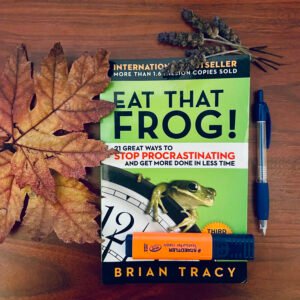
But I’ll share these 12 most powerful principles on how you can beat procrastination and be more effective based on this international best-selling book “Eat That Frog!” by Brian Tracy.
Before anything “Frog” in this book represents “the important Tasks” that you must complete.
Let’s jump right into the core of what the book is all about.
All the Lessons
Lesson 1: Set the Table
How many times it happened that you sit down to work but you don’t know what exactly you have to do. What are you trying to achieve?
So, before you start your day, write down your tasks and prioritize them.
Knowing exactly what needs to be done clears your mind from any confusion and sets the tone for a productive day.
Lesson 2: Plan Every Day in Advance
Planning is key.
Spending a few minutes to plan your day can save hours of wasted effort and directionless hustle.
I’m sure you have heard of this famous quote by the US President Abraham Lincoln
“Give me 6 hours to chop down a tree and I will spend the first 4 hours sharpening the axe”
In short, remember this 6-P Formula: Proper Prior Planning Prevents Poor Performance
Lesson 3: Apply the 80/20 Rule to Everything
Have you heard of the Pareto Principle?
This principle says, focus on the 20% of your activities that contribute to 80% of your results.
This means identifying the tasks that produce the biggest returns and prioritizing them.
One important rule that Brian pointed out is: “Resist the temptation to clear up the small things first”
So put all your focus and dedication to complete the top 20% and you’ll see Maximum output for the day!
Lesson 4: Consider the Consequences
You must think Long-Term.
Long-term thinking improves short-term decision making.
Always ask yourself, which tasks will have the most significant impact on your future?
Let’s say you are Thinking about Financial independence, that means you have to start tracking your expenses, Live below your means, save as much as possible, build an Emergency Fund, and then regularly invest. So, these are the short-term decisions that you make day-in day-out for your long-term Goal. You won’t achieve Financial Independence overnight it’s going to take years of these short-term decisions and measures that will ultimately give you that End goal of Financial Independence. But if you procrastinate on those short-term decisions…it will have negative consequences on your long-term goal of financial independence.
Lesson 5: Practice Creative Procrastination
Yes, “Creative” procrastination!
Only procrastinate on tasks that have minor consequences. Meaning, if the task is not in your list in the top 20% – Don’t do it now – Procrastinate those items – So basically use procrastination to your advantage
You can’t do everything, so choose tasks wisely.
Lesson 6: Use the A-B-C-D-E Method
Basically, Categorize tasks from A (which most important) to E (least important).
Start with A and don’t move to B unless you finish A .. and so on and so forth
This simple method forces you to prioritize and focus on what truly matters and keeps you on track!
Lesson 7: Focus on Key Result Areas
Identify where you must get results that you are completely responsible for.
Let’s say you are in a Weight training routine and your goal is to deadlift 100kg by the end of the year. It’s a slow progression right. You can’t just go on Day-1 and lift 100 kilos! Essentially there are 3 Key Areas to focus on
- Tracking Your Lifting and leveling up slowly
- Proper Diet
- Enough Sleep
So, pinpointing in these key result areas can make a huge difference to your output.
Lesson 8: Apply the Law of Three
Law of three is very interesting, it states at any given time you shouldn’t have more than 3 tasks to do! if you have 2 tasks it’s not too much and you’ll think (oh that’s not too much) you’ll get relaxed because you can do it in no time. On the other hand, if you have 4 tasks it’s quite a lot (you’ll stress out) and surprisingly on both the occasions it’ll lead to procrastination. 3 is like sweet spot! You will have the right amount of time to finish the tasks at any given time.
Identify the three things you do in your work that account for 90% of your contribution.
Lesson 9: Prepare Thoroughly Before You Begin
Prepare everything you need before you begin working on a task to ensure smooth execution.
It’s a combination of all the things that I have mentioned earlier … like have a list, writing it down, prioritise your work, Focusing on the key areas. If you are not well organized there will be too much noise and clutter that’ll derail you from achieving your goals.
Lesson 10: Take One step at a Time
Break down major tasks into smaller, manageable steps.
Take Jigsaw puzzle as an example, when you unbox the puzzle, it is overwhelming to see 1000 little pieces (seeing that you might not even start it!). But when you start building that, 1 piece at a time it gets better it gets easier. I start by building the sides first and then moving into main section. Whatever or however the task is! Take 1-step at a time and you will get there.
Lesson 11: Upgrade Your Key Skills
A lot of time we feel we don’t have the skills or the capability to do the task. So, when you upgrade your skills the more competent you become, and that enables you to achieve more.
Improving your skills is a never-ending process. So, keep learning, keep improving. It’s the only way forward.
Lesson 12: Identify Your Key Constraints
So, when you have tasks on your plate, and you don’t feel like doing anything about it. Ask yourself what the factors are that’s holding you back, maybe you don’t have the skills to do it, maybe it’s the environment, could be the tools whatever that is …. identify and try to remove those constraints and you’ll see how it’ll improve your productivity.
So, we’ve covered a lot, from setting clear priorities to tackling tasks one step at a time.
Which of these 12 lessons resonated with you the most?
Let me know in the comments below!
Remember, productivity is an ongoing journey, and you have the power to improve it day by day.